
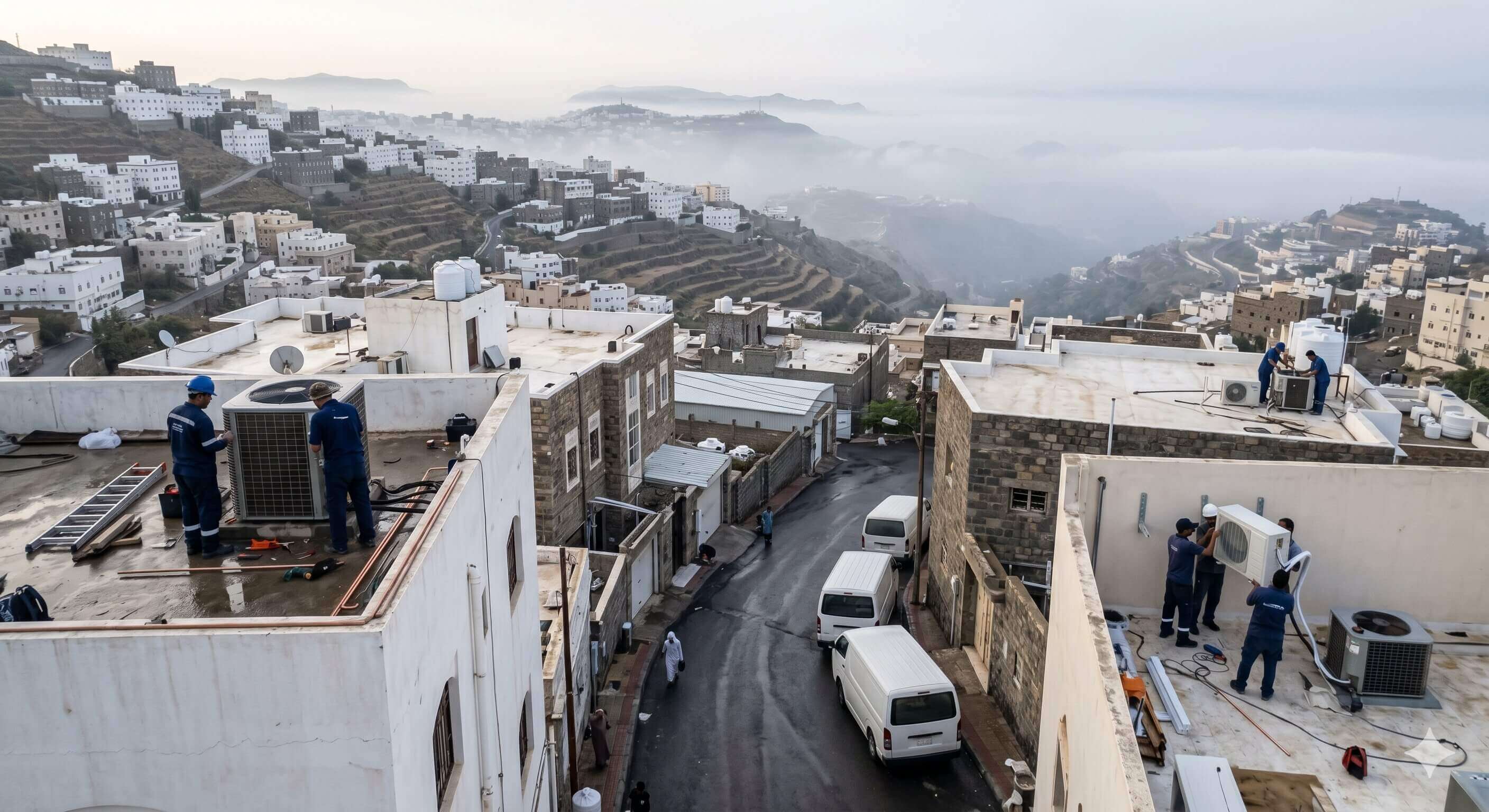
The most common mistake when buying a new AC in this region: choosing the wrong cooling capacity. A 1.5-ton unit in a room that needs 2.5 tons in Jazan runs at maximum capacity continuously — consuming more electricity and failing sooner. Our local expertise ensures the right specification every time.
At 2,200m above sea level, actual cooling efficiency drops by 8–12% compared to low-elevation cities. We recommend selecting a unit with slightly higher capacity than standard calculators suggest. This specific calibration makes a significant long-term difference in comfort and running costs.
How We Calculate the Right Size

We account for:
- Room area in square metres
- Ceiling height
- Number and orientation of windows (south-facing vs north-facing)
- Wall insulation quality
- City and elevation (Abha is different from Jazan)
- Number of occupants and heat-generating appliances
AC Types and When to Use Each
| Type | Best For | Regional Note |
|---|---|---|
| Split | Home rooms and small offices | Most widespread and efficient in the region |
| Central (Ducted) | Villas and large homes | Excellent for Abha multi-storey properties |
| Cassette | Offices and commercial spaces | Even air distribution in large open spaces |
| Window | Small rooms and temporary use | Not recommended for permanent installation |
Inverter AC — The Smart Choice for This Region's Climate
Inverter AC is the recommended standard for Abha, Khamis Mushait and Jazan. The fundamental difference: an inverter doesn't start and stop — it modulates speed up or down as needed. This saves 30–50% of electricity and protects the compressor from repeated high-current startup cycles.
Inverter in Khamis Mushait — A Necessity, Not a Luxury
In Khamis Mushait where AC runs 14–16 hours daily in July and August, a conventional unit starts and stops hundreds of times per day. Each startup draws 3–5x normal operating current — which accelerates capacitor and compressor wear. An inverter eliminates this entirely, meaningfully extending equipment life in this demanding climate.
Inverter in Abha — Cooling and Heating in One Unit (Heat Pump)
Abha needs heating in December, January and February when night temperatures reach 5°C in the upper districts. An inverter Heat Pump unit cools in summer and heats in winter at high efficiency — far better than electric heaters or oil burners. For Abha installations, we select models rated to operate down to -10°C to guarantee heating performance on the coldest winter nights.
Accurate BTU Sizing — The Region's Specific Calculations
Standard Gulf region BTU calculations do not account for Abha's elevation or Jazan's humidity. These are the variables we include in every site calculation:
Room Area × City Heat Load Factor
Standard baseline: 600 BTU per square metre. For Khamis Mushait (42°C) we increase the factor 15–20%. For Jazan (40°C + 80% humidity) we add 20–25% because humidity raises the perceived heat load significantly. For Abha (27°C moderate) we reduce from Khamis Mushait levels, then add back 10% to compensate for reduced compressor efficiency at 2,200m elevation.
South-Facing Walls and Large Windows — A Factor That Changes the Calculation
A room with a south-facing wall exposed to direct sun needs 20–30% more BTU. In Abha, a large south-facing window overlooking an exposed slope may push the requirement from 1 ton to 1.5 tons. We visit the site and calculate this before any recommendation.
Ceiling Height and Room Occupancy
A 3.5m ceiling requires 40% more BTU than a 2.5m ceiling of the same floor area. 5+ people regularly present adds the equivalent of 2,000 BTU. Together these factors determine whether 1.5 ton is sufficient or you need 2 tons — a significant difference in annual electricity cost.
Our Sub-Services
Professional split AC installation, all sizes and brands
Design and install central AC systems for homes and buildings
Cassette AC installation for offices and commercial spaces
WiFi thermostats for remote control and energy saving
Replace your old unit with a newer, more efficient one
Buy & sell used and new air conditioners